How to Fix a Dropped Stitch or Miscount Mid-Row
by Crochets Studio — Written by a longtime crocheter who has frogged more blankets than she'd like to admit, now sharing the fixes she wishes someone had taught her earlier from her Montreal craft nook.
When your stitch count looks off, stop and count stitch by stitch instead of eyeballing the row. A dropped stitch usually shows up as a loose loop or small gap a few rows down, and it can be laddered back up with your hook. A miscount just means an extra or missing stitch is hiding at the start, end, or middle of the row, and a few stitch markers will help you catch it before it spreads.
What You'll Need
- The crochet hook you're already using for the project
- 2-3 locking stitch markers (safety pins or bobby pins work too)
- Good light, ideally a small clip lamp if you're working in the evening
- A tapestry needle, in case a loop needs to be tacked down
- Optional: a short length of contrasting scrap yarn to flag the start of your row
Step 1: Confirm What Actually Went Wrong
Before you touch anything, figure out which problem you're dealing with. A stitch count that's off can mean a dropped stitch, a miscount, or both, and the fix is different for each.
Signs of a Dropped Stitch
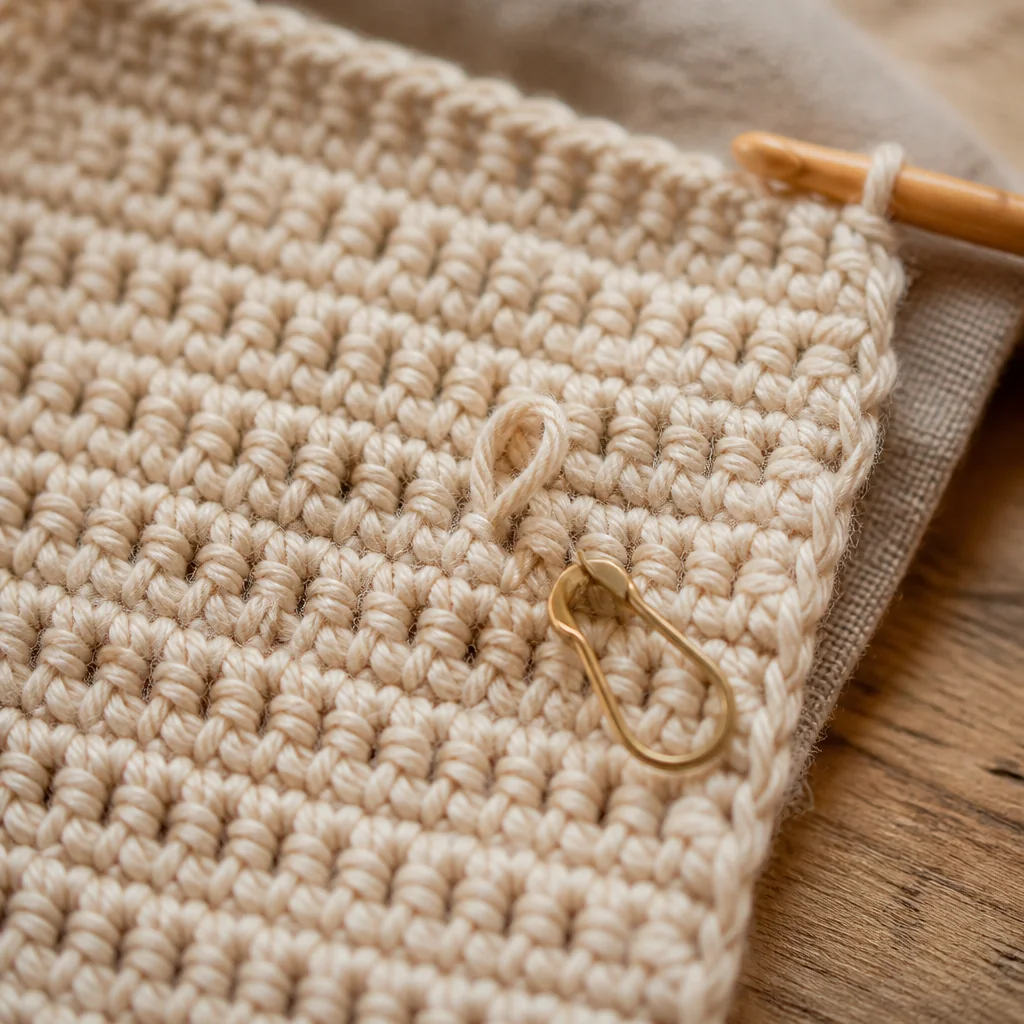
A dropped stitch usually looks like a small gap in the fabric, or a loop that's noticeably looser than the stitches around it. Stretch the fabric gently and hold it up to the light. If you see a run or a column that looks thinner than the rest, that's your dropped stitch, and it's often a few rows below your current row.
Signs of a Miscount
A miscount doesn't leave a visible hole. Instead, your row simply has more or fewer stitches than it should. This is the moment to stop and count every single stitch across the row, out loud if it helps, rather than scanning it visually. Glancing at a row almost never catches an extra half-stitch or a skipped one at the edge.
Step 2: Fix a Dropped Stitch
- Find the dropped loop. Gently spread the stitches apart with your fingers until you see the loose loop sitting a few rows down.
- Insert your hook into the dropped loop from front to back.
- Look at the strand directly above the loop, the one that belongs to the next row up, and hook it.
- Pull that strand through the loop on your hook, the same way you would for a chain. This is now your new loop.
- Repeat with each row above it, one rung at a time, like climbing a ladder, until you reach your current working row.
- Once the loop reaches the top, slip it onto your hook alongside your working yarn and continue into your next stitch as normal, or tack it in place with a tapestry needle if it's a bit loose.
Work slowly here. Rushing the ladder step is the most common way to accidentally drop the stitch a second time.
Step 3: Fix a Miscount
If You Have Too Many Stitches
- Recount the row from the very beginning, marking every 10th stitch with a stitch marker as you go.
- Look closely at any spot where two stitches sit unusually close together. This is often an accidental double stitch, where you worked twice into the same space.
- Undo just that one extra stitch by unraveling back to it, then continue forward with your working yarn.
If You're Short a Stitch
- Check the very beginning of the row first. It's the most common place to accidentally skip the first stitch after a turning chain.
- Check the last stitch of the row next, especially the top of a turning chain, which is easy to miss entirely.
- If both ends check out, work your way across the row with markers every 10-20 stitches until you isolate the section where a stitch is missing.
- Add the missing stitch back in by working an extra stitch into the correct space, then confirm your new count before moving on.
Preventing the Same Mistake Next Row
Once you've fixed the row, it's worth spending 30 seconds preventing a repeat. Place a stitch marker at the start of every row, and another every 10-20 stitches across wide rows like scarves or blanket panels. This turns a full-row recount into a quick section check the next time something feels off, and it catches problems while they're still one stitch, not ten.
When to Rip Back Instead
Sometimes a repair isn't worth the effort. If the dropped stitch is buried more than 4-5 rows down, or if you genuinely can't tell what went wrong after a careful count, it's faster and less stressful to unravel back to the last row you're confident in. Unpick to a clean stitch, re-insert your hook, and start again from there. This isn't a failure, it's just the more efficient repair in that particular case. A few minutes of frogging now is almost always shorter than untangling a mystery mistake later.
Mistakes like these are part of learning to read your stitches, not a sign you're doing something wrong. The more rows you fix, the faster you'll spot trouble before it grows.