What Is Gauge in Crochet and Why It Actually Matters
by Crochets Studio — Written by a Crochets.ca contributor who has frogged more sweaters than she'd like to admit, all because she trusted a hook size instead of swatching first.
Gauge is the number of stitches and rows you crochet within 10 cm using a specific hook and yarn, and it's how you confirm your fabric matches a pattern's math. Skip it on a scarf and you'll likely be fine; skip it on a garment or amigurumi and you risk a piece that's the wrong size before you've even finished it. A quick swatch, checked against the pattern's numbers, is the cheapest insurance in your craft bag.
What Gauge Really Means
Gauge is the number of stitches and rows you produce within a set measurement, almost always 10 cm (or 4 inches), using the specific hook and yarn a pattern calls for. Every pattern is built on math: the designer counted their own stitches per centimeter and used that number to calculate how much yarn, how many stitches, and how many rows a given size needs. When your gauge matches theirs, their math becomes your math. When it doesn't, you're building from someone else's blueprint with your own bricks, and the dimensions won't line up.
This is why gauge shows up near the top of almost every printed pattern, right after the materials list. It's not filler text. It's the one number that tells you whether the rest of the instructions will actually produce the size printed on the label.
Why Gauge Is More Than a Suggestion
It's tempting to skip the swatch, especially when you're excited to start a new project. For some projects, that's a reasonable gamble. For others, it's how a "medium" hat turns into one that barely fits a grapefruit.
Garments and fitted pieces
A sweater pattern might call for 16 stitches over 10 cm. If your own gauge comes in at 18 stitches over the same distance, your stitches are smaller and tighter than the designer's. Over a 50 cm chest measurement, that gap compounds into several centimeters of missing width, plus a fabric that drapes differently than intended. Multiply that error across sleeves, body, and neckline, and you end up with fit problems that are hard to fix after the last stitch is tied off.
Amigurumi and toys
Amigurumi patterns lean on tight, dense gauge on purpose: it keeps stuffing from peeking through the stitches and keeps proportions consistent from piece to piece. If your tension runs looser than the pattern's, you'll see gaps in the fabric, and a head that's supposed to match a body worked separately might end up too big or too small in comparison.
Scarves, blankets, and other flat, forgiving pieces
Gauge matters less here, mainly because "close enough" still produces something wearable or usable. A scarf that ends up a bit wider, or a blanket a bit smaller than planned, rarely ruins the project. This is one category where a lot of crocheters skip swatching and get away with it, though checking still avoids running short on yarn.
What Affects Your Gauge
Gauge isn't fixed. The same crocheter can produce different results depending on a handful of variables, and each one is worth checking before you blame yourself for "bad tension."
Hook size
This is the most obvious lever. A larger hook produces bigger stitches and a looser fabric; a smaller hook tightens things up. If your swatch comes out with too few stitches per 10 cm, size down. If it comes out too dense, size up.
Yarn weight and fiber
Two yarns labeled the same weight category can still behave differently. A cotton yarn with little stretch produces a stiffer, denser gauge than a springy wool blend, even with the identical hook. Fiber content, ply, and even the dye lot can nudge your numbers slightly.
Your personal tension
This is the part crocheters worry about most, and it's simply how tightly or loosely you hold the working yarn and how much tension it runs through your fingers. Some people naturally crochet tighter, some looser, and neither way is wrong. It only becomes a problem when it doesn't match what the pattern assumes.
Stitch pattern
Gauge measured over single crochet won't match gauge measured over a lacy shell stitch or a dense cable, even with identical yarn and hook. Always swatch in the actual stitch pattern the project uses, not just plain stitches, especially for anything textured.
How to Crochet and Measure a Gauge Swatch
Swatching takes about ten minutes and it's the single most reliable way to catch a sizing problem before it's stitched into an entire project.
What you'll need
- The exact yarn specified in your pattern, or your chosen substitute
- The hook size listed in the pattern
- A tape measure or ruler
- Straight pins, if you plan to block the swatch
- Scissors
Steps
- Chain enough stitches to make a swatch at least 15 cm wide, a few centimeters more than the 10 cm you'll actually measure, so the edges don't skew your count.
- Work in the exact stitch pattern called for in the project, not just single crochet, unless single crochet is what the pattern uses throughout.
- Continue until your swatch measures at least 15 cm tall, for the same reason as the width.
- Fasten off and weave in at least one end so the swatch holds its shape while you measure it.
- Lay the swatch flat on a hard surface without stretching it or squishing it.
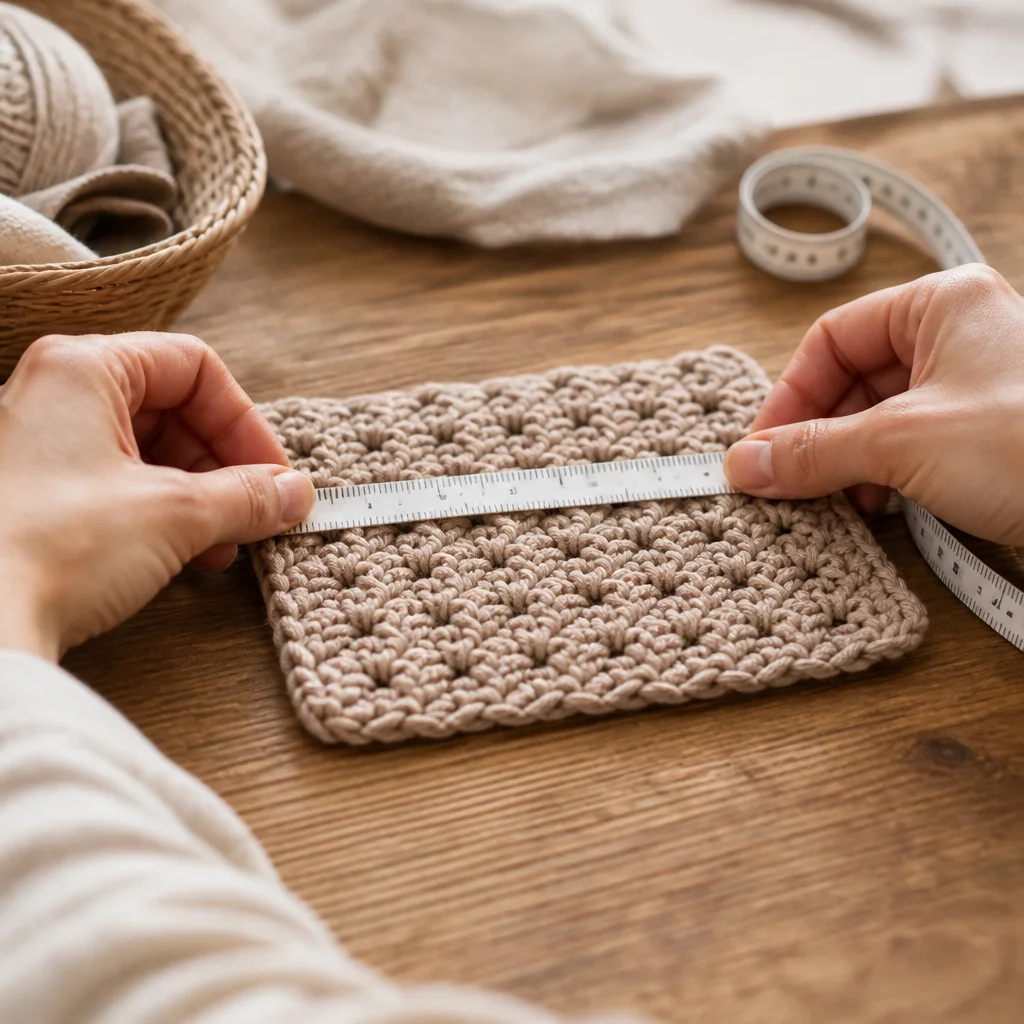
- Place your tape measure horizontally across the middle of the swatch, away from the curling edges, and count how many stitches fall within 10 cm.
- Turn the tape measure vertically over the same area and count how many rows fall within 10 cm.
- If your pattern expects the finished piece to be blocked, wet or steam block the swatch too, then measure it again once dry. Blocking can shift your numbers more than people expect.
Reading Your Results
Compare your stitch and row counts to what the pattern lists. Three outcomes are possible:
- Matches exactly: you're set, start the project with confidence.
- You have more stitches than the pattern: your gauge is tighter than expected. Go up a hook size and swatch again.
- You have fewer stitches than the pattern: your gauge is looser than expected. Go down a hook size and swatch again.
Small mismatches, half a stitch or less over 10 cm, usually aren't worth chasing for scarves or blankets. For garments and amigurumi, keep adjusting hook size and reswatching until you land inside that half-stitch window.
Common Gauge Mistakes to Avoid
- Measuring a swatch that's too small, which lets curling edges throw off the count
- Skipping the row gauge and only checking stitch count, even though row gauge matters for length
- Swatching in single crochet when the project uses a different stitch pattern
- Stretching the swatch while measuring it, which fakes a looser gauge than you'll actually get
- Forgetting to block the swatch when the pattern assumes a blocked finish
The Takeaway
Gauge isn't a test of skill and it's not about crocheting "correctly." It's about making sure your fabric matches the math the pattern was built on. Once that clicks, a swatch stops feeling like busywork standing between you and the fun part, and starts feeling like the cheapest insurance available against a wasted skein and hours of frogging later.
Next step
Try the Gauge Calculator