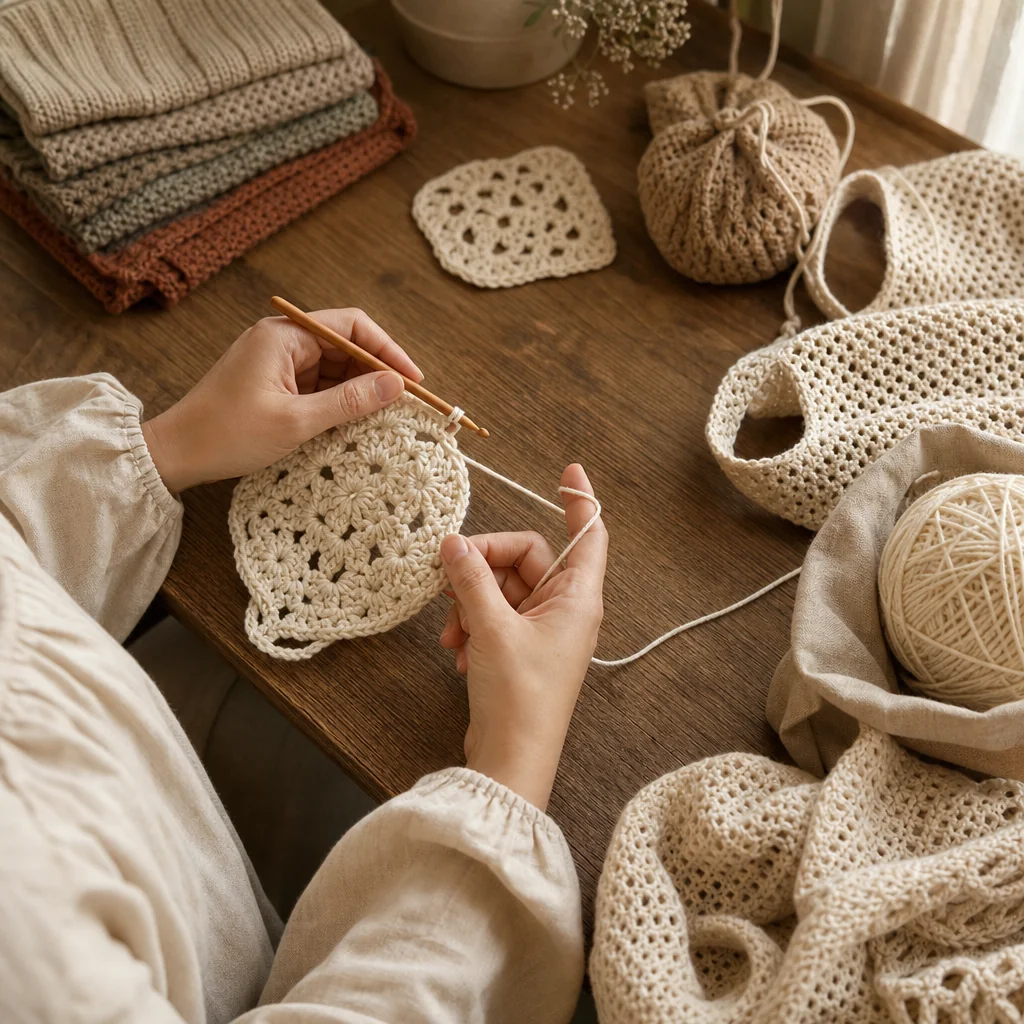
Left-Handed Crochet: A Complete Guide
by Crochets Studio — Sarah is a fiber artist and left-handed maker who learned to crochet by watching her grandmother's hands in a mirror. She loves teaching adaptive techniques and believes every crocheter deserves to feel confident with a hook in hand.
Crocheting left-handed doesn't require special equipment or different patterns—it's all about mirroring the right-handed approach. Your left hand holds the hook, your right hand tensions the yarn, and your work progresses from right to left instead of left to right. With a few simple adjustments to how you follow tutorials and read diagrams, you'll crochet with the same confidence as any right-handed maker.
Understanding Left-Handed Crochet
Left-handed crochet isn't a separate craft with its own rules—it's the same beautiful fiber art, just approached from the opposite direction. Every stitch, every increase, every pattern works exactly the same way. The difference is purely mechanical: which hand drives the hook and which hand feeds the yarn.
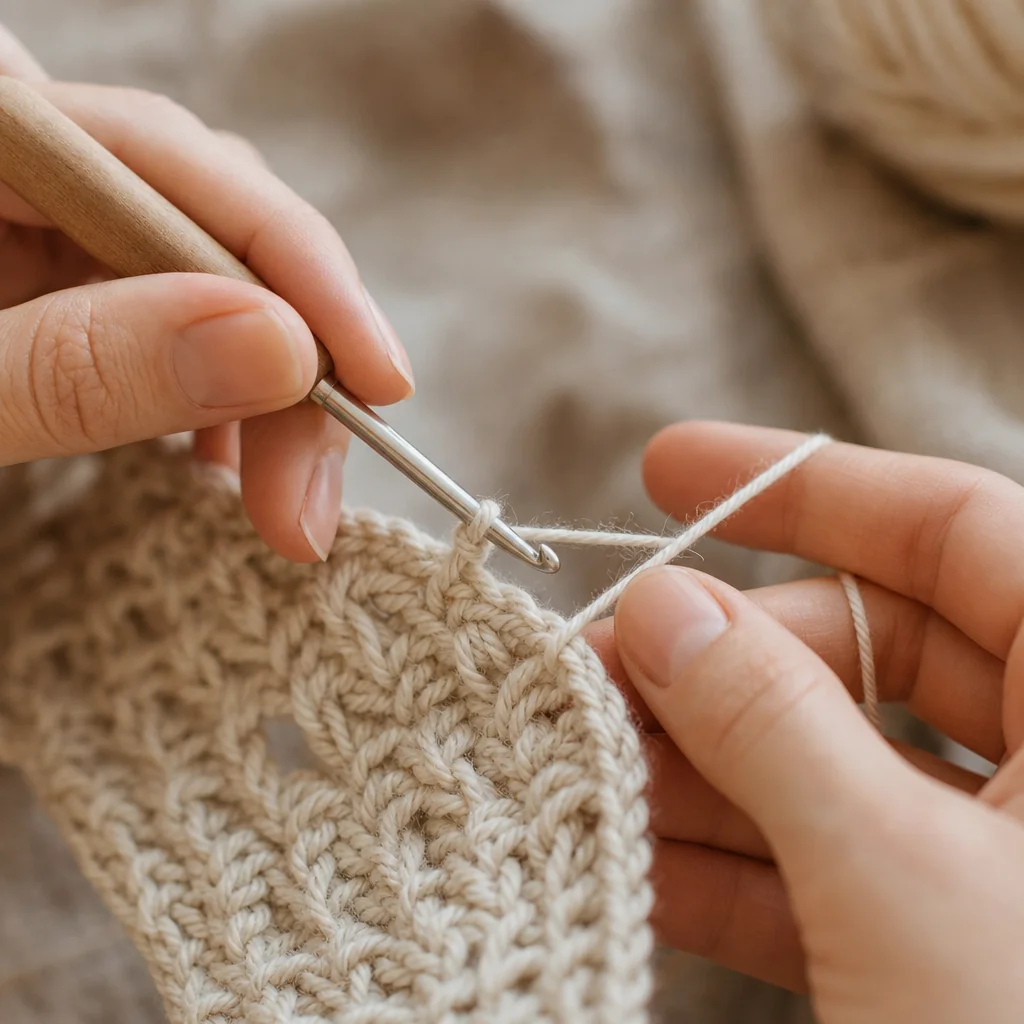
This mirrored approach means you can use any pattern, any tutorial, and any yarn or hook that right-handed crocheters use. There's no need to hunt down specialized left-handed versions or translate instructions. You simply need to understand how to reverse the visual information you're receiving and trust that your hands will find their natural rhythm.
Setting Up Your Hand Position
Holding the Hook
Your left hand becomes your dominant working hand. Hold your crochet hook in your left hand using whichever grip feels most comfortable and gives you control. The two most common grips are the pencil grip (holding the hook like you'd hold a pen) and the knife grip (holding it from above like a kitchen knife). Neither is better than the other—experiment with both and use what feels natural.
The hook should rest comfortably in your hand with enough freedom to rotate and maneuver through stitches. Your grip shouldn't be tight or tense. As you work, you'll develop muscle memory and your hand will relax into the motion.
Tensioning the Yarn
Your right hand controls the yarn tension. This is where many left-handed beginners feel awkward at first, since your non-dominant hand is doing detailed work. The yarn typically wraps around your pinky finger, runs across your palm, and feeds over your index finger to create consistent tension as you pull loops through.
Some crocheters wrap the yarn around multiple fingers, some use just the index finger, and others develop their own system. The goal is steady, even tension that lets you pull the yarn smoothly without it slipping too loose or catching too tight. This skill develops with practice, not perfection on day one.
Working Direction
When you crochet left-handed, your work builds from right to left across the row or round. Your starting chain begins on the right side of your workspace, and as you add stitches, the fabric grows toward the left. This is the exact reverse of right-handed crochet, but it produces identical results.
For projects worked in rows, you'll turn your work at the end of each row just like right-handed crocheters do. For projects worked in rounds, you'll move counterclockwise instead of clockwise around your circle or tube.
Learning from Right-Handed Resources
The vast majority of crochet tutorials, videos, and books are created for right-handed crocheters. This can feel frustrating at first, but it doesn't have to be a barrier. You have several effective strategies for translating right-handed instruction.
The Mirror Method
One of the simplest approaches is to physically mirror the video. Place a small mirror beside your screen and watch the reflection instead of watching the screen directly. The mirrored image shows you exactly what your hands should be doing. This works especially well for stitch tutorials where hand position and hook movement are critical.
Some video players and browser extensions offer horizontal flip settings that mirror the video digitally. YouTube doesn't have this built in, but third-party browser extensions can add the functionality. Mirrored video feels natural almost immediately and removes the mental translation step.
The Mental Reversal Method
Many left-handed crocheters prefer to watch videos normally and simply reverse every direction in their head. When the instructor says "insert your hook from front to back," you do exactly that—from front to back—but your front and back are mirrored. When they say "yarn over and pull through," you yarn over and pull through.
This method requires more concentration at first, but it builds a useful skill. You develop the ability to understand crochet instruction at a conceptual level rather than relying on visual copying. Over time, this mental reversal becomes automatic.
Choosing Your Strategy
Try both methods and see which one helps you learn faster. Some stitches are easier to mirror visually, while others are easier to understand conceptually and reverse mentally. You might even use different strategies for different situations—mirroring for complex colorwork, mental reversal for basic stitches.
Reading Patterns and Charts
Written Patterns
Written crochet patterns are your friend. They describe stitches using abbreviations and instructions that work identically for both hands. "Sc in next 3 sts" means single crochet in the next three stitches whether you're left-handed or right-handed. The pattern doesn't care which direction you're moving across your work.
When a pattern gives construction instructions like "work across," "turn," or "join to beginning," follow them exactly as written. The pattern describes the relationship between stitches, not the physical movements of your hands.
Charts and Diagrams
Crochet charts are visual representations of stitches, usually with symbols arranged on a grid. For right-handed crocheters, charts are typically read from right to left on right-side rows and left to right on wrong-side rows. As a left-handed crocheter, you'll often find it easier to read charts in the opposite direction—left to right on right-side rows.
However, this isn't a hard rule. Some left-handed crocheters read charts exactly as written and let their hands naturally work in the mirrored direction. Others mentally flip the entire chart. The key is consistency: choose one approach and stick with it for the entire project so your fabric comes out symmetrical and correct.
Lace and Colorwork
For intricate lace patterns and colorwork charts, pay extra attention to directional stitches. Stitches that lean or twist in a particular direction will lean the opposite way in your finished fabric if you're reading the chart in reverse. This doesn't always matter—many patterns are symmetrical enough that the reversal is invisible. But for asymmetrical designs, you might need to intentionally mirror the chart to achieve the intended visual result.
Common Challenges and Solutions
Tension Consistency
Every crocheter struggles with tension at first, but left-handed beginners often feel it more acutely because they're learning from visual references that don't match their hand movements. If your tension feels inconsistent, focus on your right hand. That's where the yarn is being controlled, and small adjustments to how you wrap and hold the yarn can make a significant difference.
Practice with inexpensive worsted weight yarn in a light color so you can see your stitches clearly. Make swatches without worrying about the final result—just focus on making each stitch feel the same as the last one.
Finding Comfortable Rhythm
Rhythm develops with repetition. Your first project might feel mechanical and awkward, but by your third or fourth project, you'll notice your hands moving smoothly without conscious thought. Give yourself permission to be a beginner and trust that your muscle memory is forming even when it doesn't feel like it.
Choose simple projects with repetitive stitches for your first few makes. Dishcloths, scarves, and basic blankets let you practice the fundamental motions hundreds of times without having to think about complicated stitch patterns.
Joining Crochet Communities
Connect with other left-handed crocheters online or in local craft groups. While left-handed makers are a minority, we're not rare. Other left-handed crocheters can share which tutorials worked best for them, recommend resources, and offer encouragement when you hit a frustrating moment.
Building Your Skills
Start with Foundation Stitches
Master the chain, slip stitch, single crochet, and double crochet before moving to more complex techniques. These foundation stitches appear in almost every pattern, and building confidence with them gives you a solid base for everything else.
Work small swatches of each stitch until your hands remember the motion without your brain having to direct every step. Once you can single crochet while watching television or chatting with a friend, you've achieved the muscle memory you need.
Progress to Shaped Projects
After you're comfortable with basic stitches, try projects that involve increases, decreases, and shaping. These techniques require you to manipulate your work in specific ways, and practicing them left-handed builds your understanding of how stitches relate to each other spatially.
Simple hats, amigurumi spheres, and triangular shawls are excellent choices for developing shaping skills.
Explore Texture and Color
Once you've built confidence with construction, explore textured stitches and colorwork. These techniques expand your creative options and prove that left-handed crocheters can execute any design a right-handed maker can.
Textured stitches like the puff stitch, bobble, and popcorn are the same regardless of hand dominance. Colorwork techniques like tapestry crochet and intarsia work identically, just in mirror image.
You Belong in This Craft
Being left-handed doesn't make you a special category of crocheter—it makes you a crocheter. The yarn doesn't know which hand is holding the hook, and the finished project doesn't show any difference. Your blankets will be just as warm, your amigurumi just as cute, and your garments just as wearable as anything made by a right-handed maker.
The slight extra effort you put in at the beginning to translate tutorials and find your comfortable grip pays off quickly. Within a few projects, you won't even think about being left-handed anymore. You'll just be crocheting.
Next step
Explore beginner tutorials